Absolute Mastery, Absolute Vulnerability
Lisette Oropesa in I Puritani at the Met

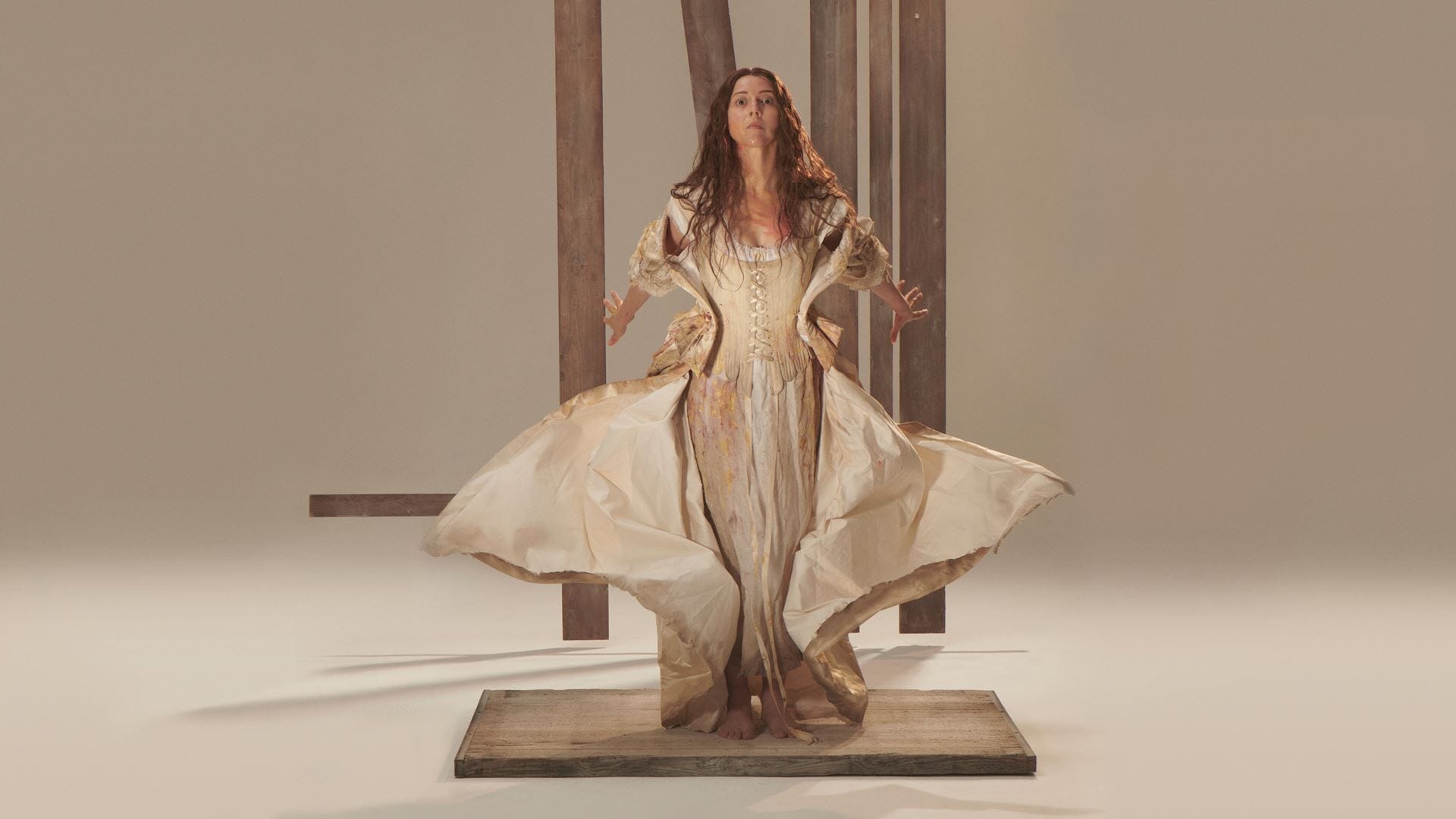
The next To a Green Thought Book Club meets February 22nd. We’ll be discussing Tezer Özlü’s Cold Nights of Childhood, first published in Turkey in 1980 and translated by Maureen Freely. It was the winner of the National Book Critics Circle Gregg Barrios Translation Prize in 2023. It’s a fascinating, very beautiful, formally innovative book—I’m very excited to talk about it with you. Book club meetings are open to all Founding Members of this newsletter. To join or upgrade, just click on the Subscribe button below.
Small Rain—Petite pluie—is out this week in French translation from Éditions Grasset. I can’t say how much I love the cover, featuring a beautiful image by Mark Armijo McKnight. A very nice first review has appeared in Libération: “tout dans ce texte semblait si éprouvé, si réel, qu’on l’a lu de bout en bout comme un authentique témoignage.”
*
The Metropolitan Opera still has the occasional hit, I guess, usually something dispiriting like The Hours; but I’m not sure I can remember the last time anything felt like such an event as the new production of I Puritani, which I saw twice last week. All my friends have been talking about it, including the few, cherished, hardcore opera queens among them, whose favorite pastime is picking singers apart and who generally view enthusiasm as a moral slip. Even those girls have been excited. It’s the Met’s first new production of Bellini’s last opera (he died, age 33, of dysentery, just months after its hugely successful premiere) in fifty years, but nobody’s excited about that—the production is a mess, and the fact that the show is anything but a disaster despite it speaks to how high the musical values really are. The first time I saw it, at the matinee on January 10, was also the Live in HD telecast performance, which always generates a thrill, and the house was as full as I’ve ever seen it—not just sold out (or close to it) on paper, but with actual bodies in the seats. Pretty much everybody even stayed past intermission. The seat next to mine was empty, though, thanks to a late betrayal by my supposed opera buddy, whose name I will in charity withhold. (It’s Mark.)
It’s been a while since I’ve reported from the Met, but long-time readers of this newsletter will applaud my bravery in showing up to such a brass-heavy show. Much to my surprise, and I don’t think this is just relief at returning to the Met after a year away, from the first notes of the opening chorale the brass sounded terrific. (The only subpar spot was a horn solo late in the second act.) The whole orchestra seemed hugely improved, almost up to the very high standard I remember from my youth, the era of James Levine in his prime. I shouldn’t let myself hope based on a single score; we’ll see how things sound at Madama Butterfly later this week. That performance will also be conducted by Met regular Marco Armiliato, who surely deserves much of the credit for how good I Puritani sounded. (It also helps that this is the third major bel canto opera the Met has presented this season; the orchestra and chorus are in full and fresh command of the style.) I admit to having largely slept on this opera, which is performed less often than Bellini’s other masterpieces, La sonnambula (which the Met put on in the fall) and Norma (which I saw at the Met in 2023). It’s a remarkable score, for my money musically more interesting than Norma; more than once it anticipates Verdi, in the vocal ensembles in general and especially in the male duets, which, though the sonorities are different (baritone / bass, not baritone / tenor), have shades of Otello and Iago. (One of the few nice touches in the Met production is to play up the homoeroticism of this, including by having Christian van Horn, who maintains a very enjoyable Instagram account, strip off his shirt. He then covered himself in white paint—the production is obsessed with paint—for reasons I didn’t understand.) The score features a wild number of moving parts, intricately related, the joints often hugely exposed.1 Armiliato more than held it together; he kept the tempi lively and mostly held the singers in check, bringing discipline to their rallentandos and ixnaying the bel canto schmooze that can make quicksand of cadenzas. It was my first time hearing the Met chorus since Tilman Michael took over from the great Donald Palumbo; they were extraordinary.
Do I have to tell you what I Puritani is about? It doesn’t matter; and really, the less said about the story—senseless in the best of circumstances, utterly incoherent in Charles Edwards’s new production—the better. But here are the basics: It’s set during the English Civil Wars of the 1640s, in a Puritan2 fortress led by Lord Valton. His daughter, Elvira, had been promised to Riccardo, a leader of the revolutionary forces; but she loves Arturo, a Royalist. Valton’s brother, Giorgio, convinced Elvira will die without Arturo, intervenes, and somehow, despite his political allegiances, Valton is persuaded to allow the marriage. But Arturo—this is so dumb, how did it ever compel anybody—sees a prisoner in the fortress and discovers it is Henrietta—sorry, Enrichetta—the widow of King Charles I, and likely to be executed when her identity is revealed. (Eve Gigliotti is excellent in this tiny role.) So, just before his wedding, he spirits her away, disguised in Elvira’s wedding veil, and Elvira, thinking she has been betrayed, goes mad. Sopranos are always going mad in bel canto opera; how else can you justify the crazy pyrotechnics? I Puritani is the only opera I can think of, though, where at the end she snaps out of it—Cromwell wins, Arturo returns, an amnesty is declared, Elvira comes to her senses: a happy ending. (Or it usually is; the Met’s staging, holding true to its perplexing choices to the very end, calls the happiness into question.)
As I say: it’s all dumb and incoherent, and the best approach, not that anybody’s asking me, would be to strip away as much of the narrative ballast as possible, to boil things down to their essence: lovers torn apart by history; a woman who makes a mistake about love. Though that wouldn’t really work, either: what’s interesting in the music is the play of public against private, the big chorus and military brass against the intimate singing among the principals; a successful staging has to capture that somehow. This new production makes the disastrous decision to try to make the story make sense: there’s a painfully misplaced comedic pantomime during the prelude, an attempt to fill in backstory; and then a new, invented timeline (imposed by supertitles) for the second and third acts. It is very confusing to be told that years have passed only to then hear this exchange—one of the opera’s emotional heat blooms—between the reunited lovers in the third act:
Elvira: How long [since you left]? Do you remember?
Arturo: Three months.
Elvira: No, no. Three centuries of sighs and suffering; three centuries of horror!
All the production’s choices were confusing to me. Riccardo is a drunk, which is plausible enough, I guess, even (especially?) among Puritan soldiers; but it also makes Elvira a painter, which is just bizarre. At a point of particular madness she holds up what seems to be a self-portrait done in an expressionist style. In the 1640s! What are we doing!
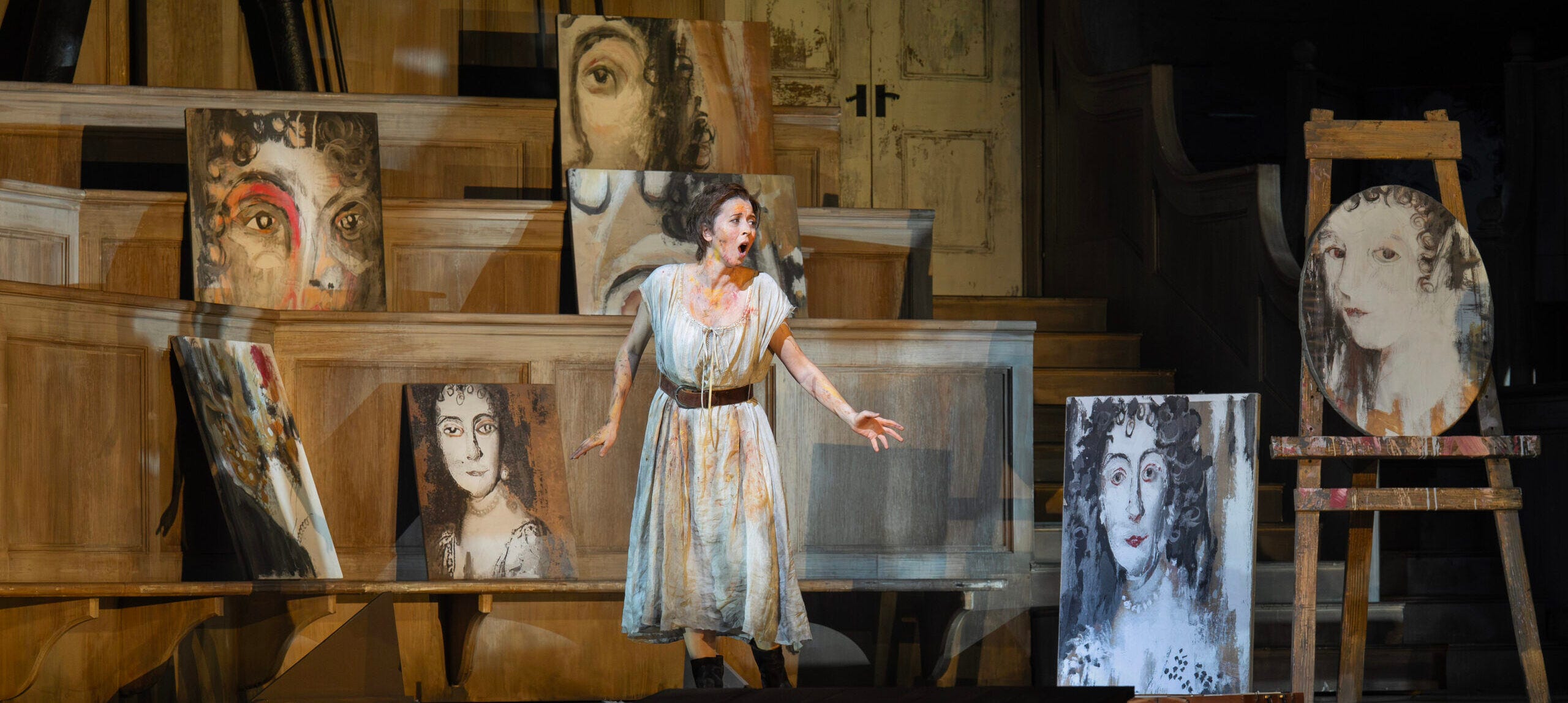
As I say, even in better stagings the story never makes sense. The only dramatically compelling element is Elvira herself, the opera’s heart. She’s on stage almost the entire show, and we see her pass through every conceivable emotion: sulky adolescent rebelliousness, joy, devastation. The vocal demands of the role are outrageous, bravura singing from first note to last. This is true of all the principals; Bellini wrote the opera for the four most brilliant singers of his day, and if ever there were a stand-and-sing opera, this is it.
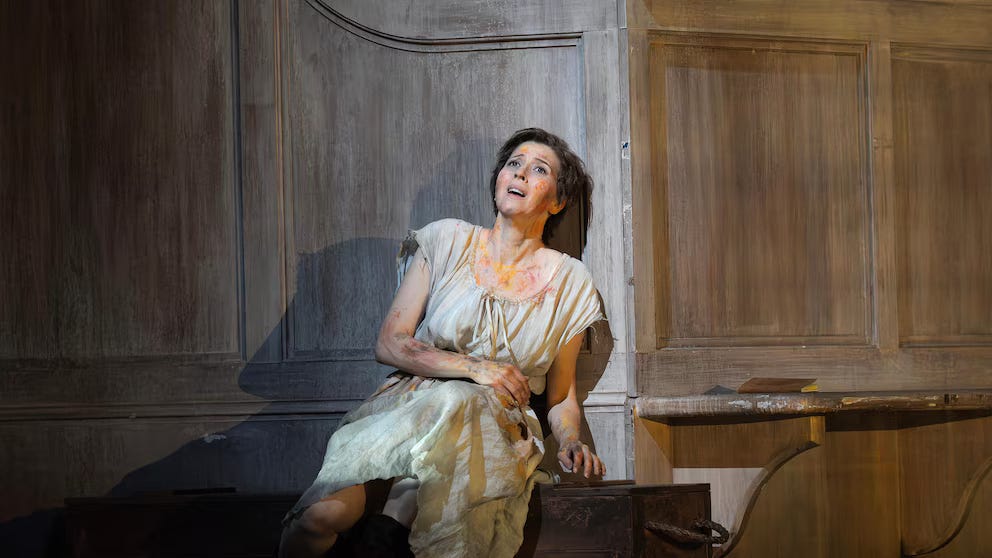
I have never heard a role so brilliantly sung as Lisette Oropesa’s Elvira on Saturday afternoon. I’ve heard other extraordinary voices; but I’ve never heard anyone sustain, over three hours, a performance in which every line is charged with such musical and dramatic intelligence. Over the past month or so I’ve listened to several of the iconic performances of the role—Callas, Sutherland, Caballé; I also watched the Met’s last telecast, with Anna Netrebko. You can’t really compare live performance to recordings, and anyway comparison is the devil; but Oropesa’s performance places her among the very best. (Only Callas’s performance is as smart.) It’s an extraordinary voice, with qualities that hadn’t been clear to me in her recorded performances. Sometimes on recordings the voice sounds slightly thin to me, but it’s not thin at all; it fills the Met’s huge space. It’s strong throughout its range, including up top; only three notes in the opera—three notes among thousands—sounded to me like they gave her trouble, in both performances I saw. They were all very high sustained tones; two of them she handled by pulling way back on the dynamic, and one, in both performances, she almost lost. It didn’t matter. The real marvel of the voice is its middle, which is incredibly rich, luxurious in a way exceedingly rare for coloratura sopranos. I’ve spent all week thinking about how to describe it, and the image I keep returning to is of a beautifully grained wood, just cut, something made equally of sunlight and earth; it gratified all the senses, not just the ear but touch as well; you felt that if sound had a smell it would smell amazing, that it would melt in your mouth.
But it’s not the voice itself that makes the performance so extraordinary; it’s the intelligence with which it’s wielded. I don’t just mean a kind of heady smartness, though there’s that, too; I mean the intelligence of technique, a bodily intelligence. In a post last year I included a short video of Oropesa talking about technique, specifically about moving the voice through the passaggio, experimenting with different placements in service not just of beauty of sound but also of drama. I love what she says—I think it’s the best definition of “technique” I’ve heard; and it was thrilling to hear it in action. I’ve never felt so strongly that every note had been thoroughly considered, thoroughly thought through; I’ve never felt a performance so full of intention. I can imagine that might seem off-putting, or that it could result in an arid, over-thought performance. It didn’t—maybe because Oropesa’s conception of technique is so alive, so improvisational, so little concerned with rules and so redolent instead of Aristotelian phronesis, practical judgment. Her coloratura passages had a machine-like precision but didn’t feel machine-like, because they were so varied in expressiveness; in the ecstatic end of her first act duet with Giorgio even her inhalations were joyful. Her phrases were living things, moving in unexpected ways; they were never the perfect languid sometimes soporific bel canto swell of a Sutherland but instead muscular, vigorous; in the mad scenes they were sometimes deliberately disordered, even jagged. She violated bel canto strictures, at least as I received them in conservatory, and thank God. In the third act, in her long descending coloratura passages, as the voice moved into chest she let it be savage, inelegant; this made Elvira’s turn-on-a-dime switches between madness and lucidity, which are objectively ridiculous, instead moving, heart-in-your-throat urgent. And through all of it her pitch was absolutely unfailing, I’ve never heard anything like it; you could hear every accidental in every melisma—which again made me feel that I had underestimated the score, which is harmonically more nimble than I had realized.
She’s superhuman, I scribbled in my notebook as I listened, but then revised myself: the marvel of her performance was how human it was, how the effect of her virtuosity—for all its brilliance—was a sense of vulnerability. That’s a quality only the greatest artists have: absolute mastery, absolute vulnerability. It was a sound to fall in love with.
Imagine how strong the other singers had to be to leave an impression with Oropesa on stage. But they did. Christian van Horn is one of the glories of this generation at the Met, a bass baritone whose sound is clear and pointed, with a rare beauty and agility; none of the Giorgios in the recordings I’ve heard handle the role’s coloratura passages so well. I’ve seen him many times now, and never heard him sing badly. But the real excitement at the Saturday matinee, beyond Oropesa, centered on Ricardo José Rivera, a young baritone who stepped in for Artur Ruciński as Riccardo. This is the stuff of opera legend: suddenly called on to sing a major role at the Met, and in a Live in HD performance, no less. Imagine what he must have felt. Riccardo has the first big moment in the opera, a bravura aria that pretty much starts the show, the first solo number. He was sensational. It’s a gorgeous voice, with plenty of metal but beautiful and open up top; in his big duet with van Horn he brought a tenor squillo to his highest notes. His coloratura passages were very impressive—Riccardo has a lot of them, and most baritones smudge their way through. Rivera’s singing was always crisp, in perfect time, no cheating. He wasn’t entirely consistent—who could be, given the circumstances—but it was a brilliant night for him; it should turbo-charge his career. It was lovely to see the cast and orchestra applaud him as he took his bow. Rivera has the potential to be a great Verdi baritone, and it will be exciting to watch his career, even if it worries me a bit that he’s already taking on roles like Macbeth. Hopefully he has good advice to help him sort through all the offers that will be coming his way.3
That leaves Arturo, sung in the Met’s production by Lawrence Brownlee—who has taken on all three tenor roles in the Met’s bel canto powerhouses the Met this season. I’ve written about Brownlee a bit before, and I’m sorry to have to end this little essay with him, because he was the only musical aspect of the evening I didn’t like. As I said in my essay on his Tamino, he should be a great singer; he can do things almost nobody else can do. The writing for the tenor in Puritani is absurd, including an infamous high F (!) in his final aria. Imagine! You’ve been singing for three hours (the tenor doesn’t appear in the second act, but still), and at the very end of the night you have to pull off a note that basically doesn’t exist anywhere else. (I don’t know of another tenor aria that has a written high F; point any out in the comments, please.) It’s almost unsingable: Pavarotti, who in his prime was famous for the ease with which he tossed off the nine high Cs in “Ah! mes amis” from Fille du Régiment, took it in pure falsetto; most tenors don’t even try it. (The alternative, a high D-flat, isn’t much easier.) There’s no way to make a beautiful sound up there, your only hope is to squawk like a trumpet. You can hear Brownlee sing it in this reel from the Met’s Instagram page; he sounds as good as anybody’s ever going to. On Saturday’s performance he only kind of sang it, though the D-flat that precedes it was solid, and in general his high notes could be thrilling—who else right now can toss off high Cs like that? At the second performance he was clearly struggling, and I was glad he skipped both high notes in his last aria.
All of which means that Brownlee, and I’m so sorry to say this, is the most gifted singer I hate listening to. I’ve heard him several times, in both staged performances and recitals, and for all the amazing things he can do he reduces me to bored tears. Even as it leaps all over the place, the voice only ever does a single thing; it always sounds the same. He fills the hall, but—very much in contrast to Oropesa—it always feels like a small-ish voice pressed beyond the possibility of expressiveness. Everything sounds fortissimo, even when he’s singing softly—it’s not a question of volume but of bloom, or the lack of it. The sound is all metallic hardness; there’s no dimension to it, no give; the voice goes nowhere, and so it leaves me unmoved. I’m being unfair: the part is impossible, even beyond the stratospheric notes; the tessitura, where the vocal line tends to hang out, lies between D and A-flat above the staff, which is just exhausting. Brownlee handles it by making his tone so nasal all his vowels sound French. That’s healthy, I support him; but it’s not all that lovely to listen to. Finally the voice is brilliant in all the ways I care about least: it’s all outward, all public-facing; it gives no sense of inwardness.
But the show belongs to Elvira, and listening to her felt like being present for a historic performance, if opera is still capable of producing them: a great singer inhabiting a role that calls on the fullness of her gifts. I felt lucky to be there.
As always, thanks for reading—
G.
To hear how badly things can go awry, listen to the live 1962 recording with Mirella Freni—who sings with gorgeous tone and very much in her own time—and Alfredo Kraus, conducted by Nino Verchi. The end of Act I is an absolute train wreck, everybody in their own rhythmic world.
The opera seems to use “Puritan” to refer to everyone on Cromwell’s side in the Civil Wars. It’s actually not at all clear what it means.
I saw Artur Ruciński the following week. He was fine, better than fine—but not as good as Rivera. Curiously, since he had sung in all the other performances, his ensemble with van Horn was notably weaker—the weakest ensemble singing of the evening.
Total agreement about the awful production: why, oh, why, with the paintings? They made no sense!
I have seen Lawrence Brownlee in person only twice, both years ago in San Francisco: he was in the last SF Opera "Don Pasquale" and I reviewed a good recital he gave. I had found his voice on the dry side, and thought he sounded warmer and richer in the broadcast of "I Puritani." I understand what you mean about a certain sameness in his singing, though I'm not sure I agree.
About Ricardo José Rivera: I've been lucky enough to see him twice in person quite recently, both times as a guest artist at Opera San José. He was a hilarious and scene-stealing Papageno in their "Magic Flute" in 2024, a production in which he and the Papagena were by far the best singers. Last year, he was a sexy Guglielmo in a good production of "Così fan tutte." It was a thrill to see him in the "Puritani" broadcast.
Lisette Oropesa was indeed marvelous. She hasn't sung at SFO in a number of years; I saw her most recently in "Les Huguenots" in Paris in 2018, as Marguerite de Valois, in which she was excellent.
Very happy to have experienced the Met HD. And relieved to be excused from figuring out why Elvira was portrayed as a painter. Surprisingly few questioned the final twist.
Did they live happily ever after, or not? Peter Brase on X informs me that Rivera has sung a number operas with Teatro Nuevo in NYC. Oropesa sang Donizetti’s Maria Stuarda at Salzburg last summer. Thrilling.