Translating Luis
On love and poetry; a poem from One Moment

LAST CALL for What is Style? Time is running out to sign up for this craft class on style, which starts June 6. Over three Saturdays, we’ll consider what style is and how we might get better at it. The reading packet for the first session will go out next week, but you don’t need to look at it before we meet; we’ll read everything together in class. (Looking at the packet beforehand will be more helpful for later sessions.) Starting with Henry James and Ernest Hemingway, polar papas of English-language style, we’ll move on to consider a range of writers, from Marilynne Robinson to Jenny Zhang, Natalie Diaz to Pedro Lemebel. All sessions will be recorded and videos made available for students who can’t attend synchronously. Full info and registration at this link.
A very remarkable book. It has been a long time since I’ve wanted to proselytize about a new book as much as I do about Ivana Sajko’s Every Time We Say Goodbye; it’s been a long time since a book by a new-to-me author has made me feel so much (to quote Dickinson) as if the top of my head were taken off. It’s formally and narratively thrilling, a very slim novel that conveys a whole pressurized life. The translation, by Mima Simic, is extraordinary; the innovative prose lives and breathes in English. We’re reading it for our next To a Green Thought Book Club, which is meeting on Sunday, June 21 at 3:00pm ET. The book club, which meets six times a year, is open to all Founding Members of this newsletter, and forgive me if I make a bit of a plug. Each 90-minute session starts with some comments from me, which I always intend to take up about fifteen minutes and sometimes, since conciseness is not my gift, extend to as much as half an hour; in that time I try to point out a few things that interest or excite me about the book. After that, we hear from as many people as time allows. As someone said in the Ben Lerner discussion last weekend (many thanks to all of you who came!), book club is a way of doubling the pleasure of your reading; it has become one of my favorite things, an important part of my reading life. It has also been a very pleasurable way to get to know some of the readers of this newsletter, who are a very smart and interesting bunch. I’d love for you to join us.
*
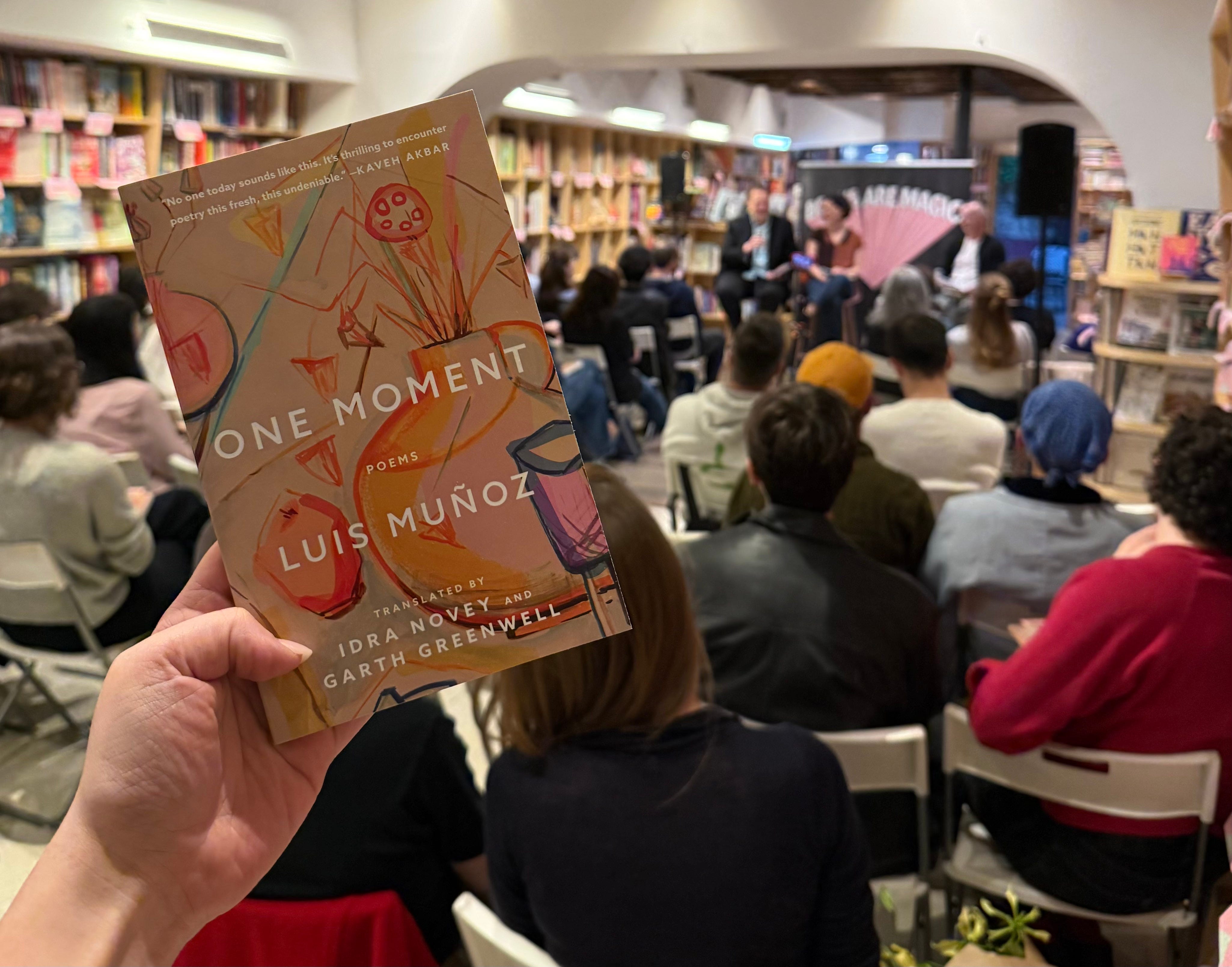
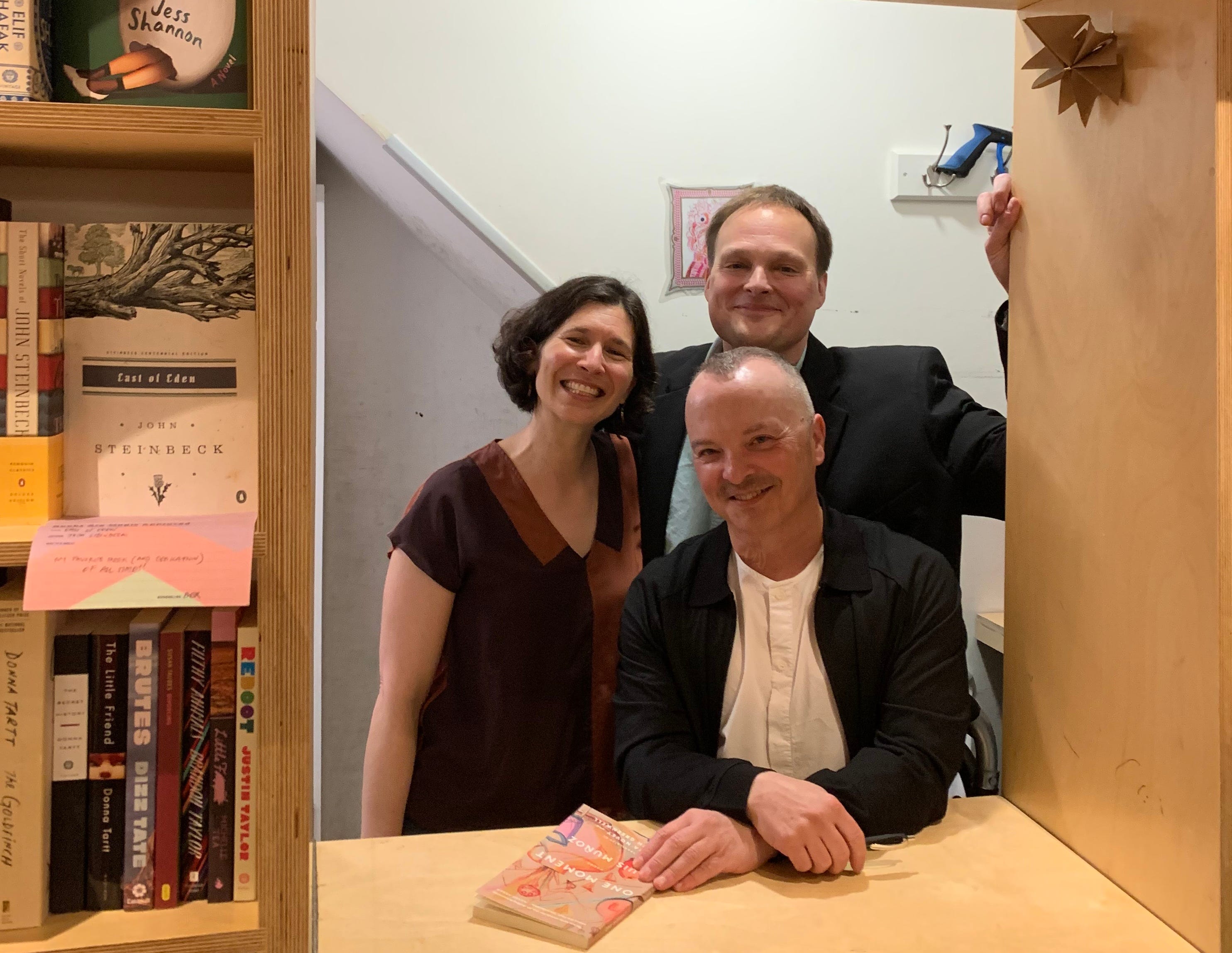
Hard to believe it was two weeks ago already, just a couple of days before I left New York, that I joined Luis and Idra Novey to celebrate the publication of Luis’s One Moment, which Idra and I translated. (Hello from Iowa City, by the way, where I’m typing this on my porch looking out at the garden.) Luis has published something like nine books of poems and is much garlanded in Spain, but this is his first American book publication. I shouldn’t have been surprised to be so nervous at the launch, which was at Books Are Magic in Brooklyn, since it’s been clear to me from the start that I am foolishly over-invested in the fate of the book (foolishly because the fate of any book is out of one’s hands). I’ve never been so jittery for any of my own events.
Happily, all went well; better than well. The bookstore was full of people, some of them strangers but many of them friends from all parts of my life, lots of them people I’ve met through Luis and Idra, even a handful of my NYU students. Afterwards a group of us went out for drinks and it felt like the best possible send-off from New York, the very best people in the very best spirits. Luis and I returned to the NYU faculty apartment that had been my home for a semester, with a view down Greene Street I will miss, with hearts very full.
Translating the poems of One Moment was a new adventure, in some ways; but it was also a culmination of something going back to the very beginning of my relationship with Luis. He and I met in September 2013, impossibly almost thirteen years ago, in the least appropriate way possible. Unbeknownst to either of us, we were set up by another professor in his department, whose class I had just started. I’ve told this story already various places, because it’s one of my favorite stories to tell: how, despite the fact that I had no Spanish (I was taking a Portuguese class), and he had very little English, we somehow managed to spend two hours over drinks talking about poetry. Not just talking about it; somehow we conveyed what poetry meant for us, how for each of us it represented a fundamental value, one of our deepest commitments. What we lacked in language we made up for with eagerness and flirtation. I remember that we laughed a lot, and that everyone else at the table seemed to disappear. I remember thinking he was the most fascinating person I had ever met.
We could have talked all night, I think, except that he and a friend had made plans for dinner. I rushed home with two priorities: first I looked up the university’s policies on professors dating students, which were (and still are, I just checked) humane: romance is prohibited wherever there is an instructional or evaluative relationship, which thank goodness didn’t apply to us. And then I googled English translations of Luis’s poems. There weren’t many, and now I can’t find the ones I stumbled across then. (The internet is a terrible repository, infinitely worse than paper; after thirteen years all that lasts is anything you wish would disappear.) They weren’t any of the handful of translations the great John Burnside did, which I would read later; they’re very free, and wonderful. Whoever they were by, they were underwhelming; I remember folding shut my laptop a little despondently and thinking, Maybe he can still be my boyfriend, even if I don’t love his poems.
We saw each other almost every day over the next couple of weeks, and it was heady enough that I don’t remember worrying much more about whether I liked his poems. Most nights I went to his place, a tiny one-bedroom on the second floor of a yellow house, just north of Mercy Hospital; Iowa Cityans will know the house I mean. I still feel nostalgic about it whenever I walk past, though Luis has no patience for nostalgia. It wasn’t all that livable, cramped and oddly shaped, and run down like almost all the beautiful old houses downtown by generations of student tenants. But it had a serviceable kitchen, where Luis, who is a wonderful cook, experimented with vegetarian versions of classic Spanish dishes; and it had a tiny splinter of a sun room that Luis turned into an office, with drafts of poems taped up on all the walls.
One night, while he was making dinner, Luis asked me to take a look at some translations that were going to be printed in a little pamphlet. Those have disappeared too, I wish I had a copy at hand so I could remember what phrase it was that seemed to me so hackneyed, so cliché, just so bad that I had to say something. Is this a really common phrase in Spanish, I asked Luis, something that people say all the time? His eyes went wide. Not at all, he said, it’s very strange, no one would say it in real life.
We realized there was a problem. The English translations of Luis’s poems were basically “correct” in the sense of each word corresponding to a meaning of the original. But that’s not really the sense of a poem; the atomistic, word-correspondence approach to translation, the approach of Google translate, of ChatGPT or Claude, can’t really get (at least not yet) at the human meanings poems communicate, which aren’t conveyed by dictionary definitions or idiom mapping but encoded in rhythm and sound, in the mysterious nimbus words accrue (their histories, their rhythms, their associations), and most of all in the ways they react with other words. Those reactions aren’t predictable or fixed, they have to be felt out, moment by moment. The translations Luis showed me that evening, like the translations I had found online, were all content, unbreathing and inert; the words had been translated, but the poems hadn’t been carried over.
We decided that somehow, for all the obvious difficulties, we had to retranslate the poems ourselves. This kicked off two weeks of intense effort, many hours a day spent working side by side. Our relationship was only just beginning, our language skills hadn’t improved, though as I really started digging into the poems I found that I wasn’t totally lost: I had good French, and bits of Italian and Portuguese, even some barely remembered scraps of Latin. Still, we needed not just dictionaries but images and videos; often we sat side by side in front of our laptops, each with dozens of browser windows open, as we tried to pinpoint the precise movement implied by a verb, the precise shade of a particular color. Most of all we needed hours and hours of conversation. What does this word feel like, I would ask Luis; where would you hear it, what kind of person would use it? We found ourselves developing a kind of private lexicon or image repertoire: words could be hot or cold, sweet or sour.
Slowly, the poems began to open up for me; I began not just to catch their meanings but in some deeper sense to understand them. This wasn’t unlike getting to know a person: I developed a feel for how the poems sounded, how they moved. I started to understand how wonderful they were.
This was an extremely inefficient process, the most lavish, least cost-effective effort. I had just started an MFA program, I should have been focusing on my own work, getting my novel ready for agent queries. How could I justify spending those weeks focused on another writer’s work, especially when, at the start of the process, I wasn’t sure whether I even liked that work? Because Luis was so beautiful, obviously; and luckily for me I’ve always thrown myself at love. Because it’s clear to me now, looking back, that it was in those weeks of heady intense intellectual labor, as I came to know those poems as deeply as I could, deeply enough to try to make some version of them in my own language, that I fell in love with Luis. Translating his poems was a kind of absolute intimacy; it gave me a chance to meet him, to get to know him, in his deepest expression of himself. I remember asking Luis to read the poems aloud to me and listening to them mostly as music, at first recognizing only the most elemental words: bread, sea, sky. I say intellectual work, but it was erotic, too. The usual excitements of the first months of a relationship—the exhilaration of exploring another’s mind, another’s body, the expansion of existence that is falling in love—were wrapped up with discovering Luis’s poems.
Translating Luis’s most recent collection felt like a return to those early days, despite all the differences between then and now. I speak Spanish pretty well these days, for one thing, and Luis’s English is a lot better, too. But our process hasn’t really changed: we work towards a first draft of each poem in the same way, through hours of conversation. It’s such a privileged way to work: talking endlessly about Luis’s intentions (which often become clearer for him as a result, sometimes leading to changes in the original text), talking about the implications of various possibilities in English; listening to the lines in each other’s voices, trying to find a music in English as compelling as Luis’s Spanish.
But working on the book also felt like something more: like recovering a part of myself, a writerly part, I sometimes fear I’ve lost. As you know if you’re a regular reader of this newsletter, I started writing poetry when I was nineteen or twenty, and planned to dedicate my life to it: I did an MFA in poetry right after college, and then half of a Ph.D. before dropping out to spend seven years teaching high school. While living abroad, I started writing fiction, something I had never planned to do; and for reasons I can’t really articulate, writing fiction cut me off from poems. Well, maybe the biggest reason—and I’ve written about this before, too—is that I knew, after I wrote the first section of what would become my first novel, that it was much better than my poems, so much better that somehow it destroyed the poems. I don’t understand this at all: I couldn’t see them anymore as drafts I might keep working on and make better; somehow the prose drained them of all life.
This was a crisis: who was I without poetry, which was my whole life? It took a friend to point out the absurdity of despairing because I had done my best writing. Still, the loss of poetry—and it did feel like a loss, even though I gained prose—was a source of real mourning. It still is. When I first met Luis, it had been four years since I had written a poem. Now it has been (impossible!) seventeen. I still hope someday to return to poetry—but that’s exactly the wrong way to put it. I still hope someday poetry will come back.
In any event, translating Luis’s poems all those years ago—trying to find equivalents in English for Luis’s interior rhymes, for his complex, elegant rhythms—felt like using muscles that had lain too long dormant. Where his lines adopted classical verse forms in Spanish, for instance, eight- or eleven-syllable lines, I tried to echo them, even if only loosely, in ballad meter or iambic pentameter. Of course translating isn’t the same as writing an original poem, but it makes use of many of the same faculties, and working on Luis’s poems felt—it still feels—like returning to my beginnings as a writer. And also like returning to the sources of my own medium, the English language. Poetry lives closer to those sources than prose, I think, which is why prose writers should engage as deeply as we can with poetry: reading it, memorizing it, writing it.
But all of this was only half of translation, it only got us to a first draft. I realized early on that translating your partner is a fraught endeavor, even in the best of circumstances; I knew we needed to bring somebody else in to help. When Luis and I talked about ideal collaborators, the obvious choice was the brilliant poet, novelist, and translator Idra Novey. I’ve known Idra since 2016, when we met on the weirdly intimate crucible that is the debut novel circuit. Idra had already published several books as a poet and translator, but her first (wonderful) novel, Ways to Disappear, came out the month after mine, and we did a handful of events together, the happiest leg of that first book tour. Quickly she became one of my dearest friends. Idra is fluent in Spanish, which is the language of her household, and a much more experienced translator than I am. And, not unimportantly, Luis loves and trusts her.
There was a lot of laughter at the Books Are Magic event, which was also true of how Idra and I worked on Luis’s poems. As I said at that event, I am a terminally earnest person, which means I’m not ideally equipped to capture some of the most wonderful effects of Luis’s poems: their playfulness, their lightness and quick humor, their fleetness of foot. Precisely those qualities are among Idra’s special gifts, and she brought them to our new collaboration. She was also less inhibited than I was, readier to depart from fidelity to Luis’s poems. The first round of translation work with Luis was a luxury, and I think really important for the translations that resulted; but it also made me feel maybe a little too bound to the originals, too concerned with too exact a correspondence. Idra suggested new leaps and apertures; she shook things up; she let in air. We went back and forth, back and forth, more times than I could count. In the early rounds I would take the new versions to Luis, talking through with him the implications of our new choices; but eventually it felt important that he step away, so that Idra and I could feel free to make versions that fully lived in English, independent of their originals.
Publishing a book always feels like turning privacy inside out: you work for years on something nobody else knows about, and then suddenly it’s out in the world, for everybody to see. That feels especially true with the poems of One Moment, which began as something shared between partners, then opened up to include a friend, and now exists out in the world. That sense of privacy shared is intensified because so many of the poems draw from the life that Luis and I share; and intensified again because Luis was writing many of them while I was working on Small Rain, which also draws from our life together. There’s often something uncanny for me in reading Luis’s poems, a kind of déjà vu, taking in a familiar scene from a new angle, catching unexpected glimpses of myself.
I’ve always thought that two writers living together would be a recipe for disaster, and often enough it is. But also it has its rewards. Our house in Iowa is very much a writers’ house, full of places to work. Of the three rooms upstairs we’ve made one our bedroom and one Luis’s office; the largest, the master bedroom, is a common studio, with two desks that face each other. That’s where we did the bulk of work on the translations, much to our cats’ delight; many of their happiest moments come when we’re all together in that room, and they can wander from one table—one lap—to the other, or sprawl on the rug in between.
My primary studio is downstairs, in a converted garage; I transferred its brick floor to the house in Small Rain so I could write about how much I love it. Nothing is off limits to anybody, we can come in and out of anybody’s room when we want; but we tend to spend the working day toiling on our own projects in our own spaces. At the event Luis described what that feels like, the energy of working in the house together, with him on the second floor and me on the first, the way we can feel each other working in our separate parts of the house, the encouragement that is. I was moved listening to him; he was doing something his poems often do, naming a feeling for me. Because it’s true that there’s something special about those hours when we’re each writing, a kind of force that fills the house, a sense of shared endeavor. Poetry upstairs, prose on the ground floor; cats wandering all day between them.
Hearing Luis describe that at the Books Are Magic event made me feel—not that I don’t often feel this, in a lowkey way, but it came the other night all at once, a suddenness or shock—how lucky it all has been. How could we ever have imagined it, all those years ago when I first tried translating his poems, what our life would become?
*
I want to end this dispatch by sharing one of Luis’s poems, one of my favorites from One Moment, which also appeared a couple of months back in The New Republic. (Please do get a copy of the book—from your local bookstore, or from Bookshop, or from any of the other links you can find here.) Like most of Luis’s poems it’s short; blink and you might miss it. And like all of his poems, at least as I experience them, it keeps resonating past the final line, expanding and gathering density. Here it is in Spanish:
PIEDRAS
Montoncitos, testigos
tangibles, cuánto
en dibujo,
en volumen,
al perderme
ayudáis.
And in our translation:
STONES
Little heaps, tangible
witnesses, how much
in your design,
your volume,
whenever I get lost,
you help me.
There aren’t words for how much I love this, or how profound it seems to me. There’s a physical pleasure for me in the cast of the sentence, which we worked to preserve in English, the way, after the doubled address, the sentence suspends the construction “how much … you help me.” There’s a stateliness in it, how each of the three lines of the mid-branch interruption is its own unit, marked (in English at least) with a comma. When you finally reach it, the last line changes your sense of the poem, of its stakes, with that verb, which tells us that the speaker has been, and will be again, someone in need of help. But there’s nothing hurried, nothing out of breath, in the arrival; the poem isn’t calling out for help but acknowledging help received.
It’s easy to imagine a concrete situation, or something like it: little piles of stones marking a trail, maybe, a hiker moving from one to the next. But of course the poem isn’t only that, or maybe it isn’t that at all. It isn’t as sign that the speaker is grateful for the stones, it isn’t (or isn’t just) that they point a way; it’s the stones themselves, in their “dibujo,” their “volumen”—that is, in their characteristics, their objecthood—that help him. “Volumen” was easy to carry over into “volume,” but “dibujo” was a little harder. It means, literally, “drawing,” but “in drawing” doesn’t work in English. We might have said “line” or “outline,” but “design” seemed more elegant, and also truer in sound, preserving the initial consonant, the initial unstressed syllable.
How marvelous is “tangible / witnesses.” Witnesses to what? To a path, maybe, a way to be unlost; but also (or maybe these are the same thing) to the speaker himself. The sense it gives me, and I’m not at all sure that Luis would agree, is that in existing the stones somehow witness to, affirm, the speaker’s existence, too. I don’t think this is quite animistic, there’s not much superstition in Luis’s poems, and certainly none of the vague atheistical God-like outline that hovers all over the place in my own writing. But I do think there’s a sense of something reciprocal, something given and received. It reminds me of one of my other favorite poems, by George Oppen, his wonderful “Psalm,” with its opening gasp of wonder:
In the small beauty of the forest
The wild deer bedding down—
That they are there!
It’s that feeling—“That they are there!”—I sense in “tangible / witnesses,” the nature of the help they give. Like Oppen’s poem, Luis’s feels, in its entirely secular way, like a prayer—not asking for anything but giving thanks, acknowledging a blessing. A poem in praise of being.
As always, thank you for reading—
G.
After reading Luis's deceptively simple poem, I dashed out to buy the collection. I did think of W.C. Williams when I read this poem -- the essential nature of "things," the essence in things. Thank you for sharing the full story around the poem.
Can I swallow/ memorize this entire post for immediate recall whenever I want/need? So beautiful...can't wait to get Luis' book.